Your Limit Orders Are Getting Picked Apart Before They Even Execute — Here's the MEV Playbook Nobody Explains
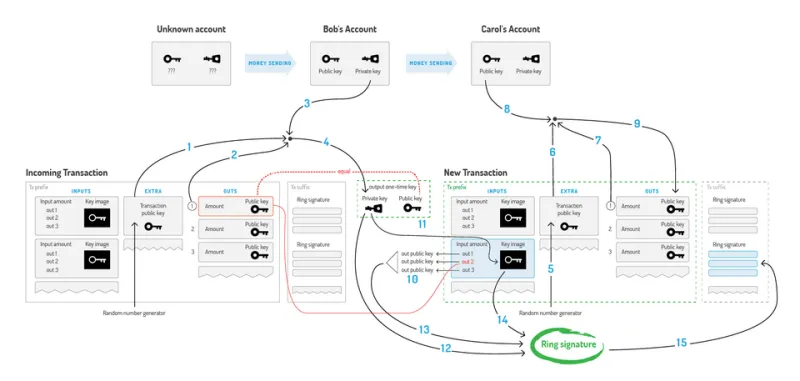
Photo: CryptoNote official site, CC BY-SA 3.0, via Wikimedia Commons
You set a limit order. The price hits your target. And somehow — somehow — you still get a garbage fill. Or worse, the order just... doesn't go through. No error message, no real explanation. Just a transaction that quietly died in the mempool while someone else walked away with your edge.
This isn't bad luck. It's not a bug in the DEX interface. It's MEV — Maximal Extractable Value — and on Solana, it's a well-oiled system that most retail traders are completely in the dark about.
Let's break it down.
What MEV Actually Means (In Plain English)
MEV stands for Maximal Extractable Value, and it refers to the profit that can be pulled out of a blockchain by controlling the order in which transactions get processed. Think of it like this: if you know what trades are about to happen — and you have the power to jump in front of them or slip transactions in between them — you can essentially trade with perfect information.
On Ethereum, MEV became a massive conversation years ago. Solana was supposed to be different. Faster finality, a different consensus model, no traditional mempool in the same sense. But here's the thing — Solana still has validators, and validators still choose which transactions get bundled and in what sequence. Where there's ordering power, there's extractable value. It's that simple.
Solana's architecture actually creates some unique MEV dynamics. Because transactions process so fast, the window for extraction is compressed — but it absolutely still exists, and the players operating in that window are sophisticated.
The Sandwich Attack: Your Trade Is the Filling
The most common MEV strategy hitting retail traders is the sandwich attack. Here's how it plays out step by step.
Say you're swapping SOL for a mid-cap token on a Solana DEX. You send the transaction with a standard slippage tolerance — let's say 1%. A searcher bot (more on those in a second) is watching the network constantly, scanning for transactions exactly like yours. It spots your swap.
Here's what happens next:
- The bot fires a buy order for the same token, timed to land just before your transaction.
- Your swap executes — but now the price has already moved because of the bot's buy, so you fill at a slightly worse rate.
- The bot immediately sells right after your trade clears, pocketing the difference.
You were the filling in that sandwich. The bot's two slices of bread — the front-run buy and the back-run sell — extracted value directly from your trade. You paid more than you should have. The bot profited. The validator may have earned a tip for including those transactions in a favorable order.
This isn't hypothetical. Research from various on-chain analytics firms has estimated that sandwich attacks across Solana DEXes extract millions of dollars from retail traders each month. The exact number is hard to pin down because a lot of it happens in ways that don't get flagged or reported, but the losses are real and they compound over time.
Searchers, Validators, and the Infrastructure Behind the Extraction
So who's actually running these bots? They're called searchers — highly technical operators (sometimes individuals, sometimes small teams or firms) who write and deploy automated strategies to find and exploit MEV opportunities in real time. Think of them as arbitrageurs on steroids, except instead of just finding price discrepancies across exchanges, they're actively manipulating transaction order to create the discrepancy themselves.
Searchers submit what are called bundles — groups of transactions packaged together with a priority fee (a tip) attached. They send these to validators or to MEV infrastructure providers who can guarantee inclusion and ordering. The validator gets a cut. The searcher gets the spread. You get a worse fill.
On Solana, this ecosystem has matured significantly. Tools like Jito — a Solana client fork specifically built to support MEV infrastructure — have formalized the process. Jito introduced a block engine and a tip distribution system that lets searchers bid for transaction ordering. It brought more transparency to MEV than existed before, but it also turbocharged the extraction business. More sophisticated players entered. The competition got fiercer. And retail traders remained largely unaware any of this was happening.
Why Limit Orders Are Especially Vulnerable
Market orders are bad enough when it comes to MEV exposure. But limit orders carry their own specific risk that often gets overlooked.
When you place a limit order on a Solana-based DEX or aggregator, that order often sits in a queue waiting for price conditions to be met. During that waiting period, your order parameters are visible to anyone watching the chain. Searchers can see the price level you're targeting, the size of your order, and the slippage you're willing to accept.
If a large market move is incoming — or if a searcher can manufacture the right conditions by moving liquidity around — your limit order becomes a target. It can be triggered deliberately in a way that maximizes extraction before or after your fill. You get your execution, technically. But the price discovery around it was manipulated.
Smaller traders with tighter slippage settings sometimes find their transactions simply fail repeatedly, because bots are constantly moving the price just outside the tolerance window. You burn transaction fees on failed attempts while the bots keep fishing.
What's Being Built to Fight Back
The good news is that MEV on Solana isn't going unaddressed. Several solutions are in various stages of development and deployment.
Private transaction relays are one approach. Instead of broadcasting your transaction to the public network where every searcher can see it, you route it through a private channel directly to a validator. No public visibility means no front-running window. Some DEX aggregators are starting to integrate these options, though adoption is still early.
Commit-reveal schemes are another tool being explored. The idea is that you commit to a transaction (basically a cryptographic hash of what you're about to do) before revealing the actual details. By the time searchers know what you're trading, it's too late to sandwich you.
Fair ordering protocols aim to remove the validator's ability to arbitrarily reorder transactions. If transactions are ordered by arrival time in a verifiable way — rather than by who paid the biggest tip — the sandwich attack becomes much harder to execute reliably.
Slippage management is the most accessible tool available right now. Tightening your slippage tolerance makes you a less attractive sandwich target (though it increases the chance of failed transactions). Some traders use very low slippage on large-cap, high-liquidity pairs and accept slightly higher failure rates as the cost of protection.
What You Can Do Right Now
You don't have to wait for protocol-level fixes. A few practical adjustments can reduce your MEV exposure today:
- Use DEX aggregators that offer MEV protection modes. Jupiter, for example, has been developing features aimed at reducing sandwich exposure. Check what protections your preferred platform offers.
- Break up large orders. Smaller trades are less attractive targets than one big swap.
- Trade during lower-traffic windows. Searchers compete hardest when the network is busy. Off-peak times mean less competition for your transaction.
- Watch your slippage settings. High slippage tolerance is basically an invitation. Keep it as tight as your trade can reasonably tolerate.
MEV isn't going away. The incentives are too strong and the infrastructure too entrenched. But understanding the mechanics puts you ahead of the majority of retail traders who are still chalking bad fills up to "volatility" or "DEX weirdness." The Solana ecosystem is building real solutions — and the more traders demand them, the faster they'll arrive.