The IRS Doesn't Care How Fast Solana Is — Your Crypto Taxes Are Still a Mess
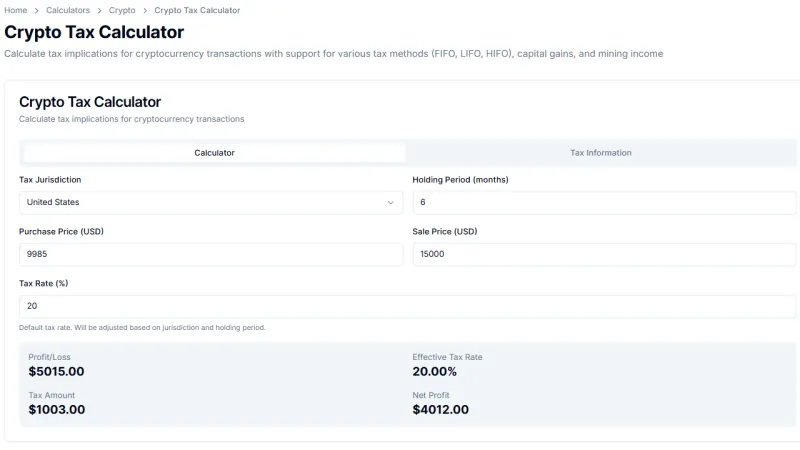
Photo: cryptocurrency taxes paperwork stress calculator, via freecalculators.ai
Let's be real for a second. When you're flipping tokens on Jupiter, stacking yield on Marinade, or rotating in and out of memecoins at 3am, the last thing on your mind is a W-2 equivalent for your on-chain activity. But the IRS? They're very much thinking about you.
Solana's speed and low fees are genuinely incredible for traders. Sub-second finality and transactions that cost less than a penny make it easy to move fast and stay nimble. The problem is that same frictionless experience makes it dangerously easy to rack up hundreds — sometimes thousands — of taxable events without even realizing it. And unlike that one stock you forgot about in your Robinhood account, crypto tax obligations don't just disappear.
Here's what's actually going on under the hood, and what you can do about it before the panic sets in.
Every Swap Is a Sale — Yes, Really
This is the one that catches people off guard the most. When you swap SOL for USDC on Raydium, or trade a random token for another on Orca, you're not just moving assets around. In the eyes of the IRS, you've sold one asset and bought another. That means you've potentially realized a gain or a loss — and it needs to be reported.
On a chain like Solana where gas fees are negligible, it's incredibly common for active traders to execute dozens of swaps in a single session. Each one of those is a taxable event. If you've been doing this all year without keeping records, you're looking at a documentation nightmare when filing season rolls around.
The cost basis — what you originally paid for the token — matters a lot here. If you bought SOL at $20 and swapped it out at $150, you've got a capital gain on that spread. Do that a hundred times across different tokens with different entry points and holding periods, and you've got a spreadsheet situation that would make a CPA sweat.
Short-Term vs. Long-Term: The Holding Period Game
Not all gains are taxed the same way. Crypto held for more than a year before being sold or swapped qualifies for long-term capital gains rates — which top out at 20% for most people, versus up to 37% for short-term gains taxed as ordinary income.
For most active Solana traders, the honest reality is that most of their gains are short-term. The whole appeal of Solana is speed. You're not exactly diamond-handing a memecoin for 13 months. That means if you've had a profitable year, a substantial chunk of those gains could be taxed at your regular income rate.
This isn't a reason to stop trading — it's a reason to be strategic. If you've got positions you're up on and have held for close to a year, it might be worth waiting out that long-term threshold before exiting, especially on larger positions.
Yield Farming and Staking: The Income Nobody Wants to Report
Here's where it gets even messier. If you're staking SOL with a validator, providing liquidity on a DEX, or farming yield through any of Solana's DeFi protocols, the rewards you receive are generally treated as ordinary income at the time you receive them — not when you sell them.
That means if you received 10 SOL in staking rewards when SOL was trading at $180, you owe income taxes on $1,800 right then and there. If SOL then drops to $80 and you sell, you've now got a capital loss — but you already owed income tax on the higher value. It's a brutal combo that a lot of yield farmers don't anticipate.
Liquidity provision adds another layer. When you deposit token pairs into a pool and receive LP tokens in return, that may or may not be a taxable event depending on how it's structured — and the IRS guidance here is still evolving. When you withdraw and receive different ratios of tokens than you deposited, impermanent loss comes into play in ways that are genuinely complicated to account for.
The Solana-Specific Wrinkle: Micro-Transactions Add Up
Because Solana transactions cost almost nothing, it's easy to forget you're even making them. Claiming rewards, compounding yield, rebalancing a position — all of these can generate taxable events that feel invisible because they're so cheap and fast.
Compare this to Ethereum, where a $40 gas fee acts as a natural brake on how often you transact. On Solana, there's no friction to slow you down, which means your tax footprint grows a lot faster than you might expect. A hundred micro-transactions at $0.001 in fees are still a hundred taxable events.
Practical Moves to Get Ahead of This
Start using a crypto tax tool now, not in March. Platforms like Koinly, TaxBit, and CoinLedger all support Solana and can pull your on-chain history automatically via your wallet address. The sooner you connect your wallets, the better. Waiting until tax season means you're doing cleanup work under pressure.
Keep a record of your cost basis method. The IRS allows different accounting methods — FIFO (first in, first out), HIFO (highest in, first out), and specific identification. HIFO tends to minimize gains in a bull market by selling your most expensive lots first. Talk to a tax professional about which method makes sense for your situation.
Separate your wallets by activity type if you can. Having a dedicated wallet for long-term holds versus active trading makes sorting through your history a lot cleaner. It's not always practical, but even a rough separation helps.
Don't forget about NFTs and token launches. Minting an NFT, receiving tokens from a launch, or participating in an IDO all have tax implications. If you received tokens for free and they had market value at the time, that's income.
Losses are your friend. Tax loss harvesting — intentionally realizing losses to offset gains — is a legitimate and widely used strategy. If you're holding bags that are underwater, selling them before year-end can offset some of your winning trades. Just watch out for wash sale rules, which don't technically apply to crypto under current law but could change.
The Bottom Line
Solana is one of the best ecosystems to trade in right now. Fast, cheap, and full of opportunity. But "cheap to transact" does not mean "cheap to ignore." The tax obligations follow the profits, and the IRS has made it increasingly clear that crypto is on their radar.
Getting ahead of this stuff isn't glamorous. It doesn't feel like alpha. But walking into April with clean records and a strategy is a whole lot better than scrambling to reconstruct a year's worth of on-chain activity while staring down a potential audit.
Your edge on Solana isn't just about finding the right trades — it's about keeping more of what you make.